Renovation Design and Historic Restoration by Designers Who’ve Actually Built Things
A Designer that Builders Didn’t Want You to Know About
For years, contractors across North America kept our name off the drawings.
They’d hire us for the architectural design work, present the renderings to clients, collect the praise, and quietly crop our name from the title block before anyone asked questions. “You’re our competitive advantage,” they’d say. “We’d rather our competitors not figure out who’s doing this.”
That arrangement worked until it didn’t. The homeowners hiring those contractors deserved the same quality of design work directly. That’s why this site exists.
40 Years of Renovation Design Built on a Simple Premise
Most architectural designers have never held a tool on a job site. They design from reference books, pass drawings to draftsmen, and call it done. We know this because a prominent Toronto architect told us exactly that, thirty-five years ago, standing next to a curved pergola we’d just built that would end up in architecture magazines across North America.
His name was John Wilkins. He worked in the city’s most exclusive neighborhoods. He said two things worth remembering.
“Don’t go to U of T for architecture. They’ll just bury your ideas under what’s been done before.”
Then: “I never went to architecture school either. I just pass my designs to draftsmen, and for larger buildings, to engineering firms for their stamp.”
That sent us down a research rabbit hole. What we found wasn’t flattering to the profession. Most architects were cutting and pasting details from the same reference books. Even Frank Lloyd Wright, whose roofs famously leaked, had much of his celebrated work produced by underpaid assistants.
We went a different direction.
Historic Restoration Requires Reading What the Building Actually Says
Forty years of renovation work teaches you to read buildings the way a pathologist reads evidence. What materials were used and why. What the builder couldn’t afford and what they substituted. How a structure grew across generations and what each addition reveals about the people who built it.
Two projects on the Mashantucket Pequot reservation in Ledyard, Connecticut demonstrate what that looks like in practice.
The first was Aunt Matt’s homestead – a collapsed gambrel-roofed structure documented in a museum postcard and a single interior photograph of a woman canning preserves. From those two images we produced site and exterior renderings, finish maps, and basic elevations – working with what we could see and nothing more. When the pre-collapse photographs arrived later, the picture changed completely. We could now place the cobbled interior staircase visible behind Aunt Matt in the canning photograph, develop full interior renders, and produce proper construction drawings. The early model held up. The additional material just let us go deeper.
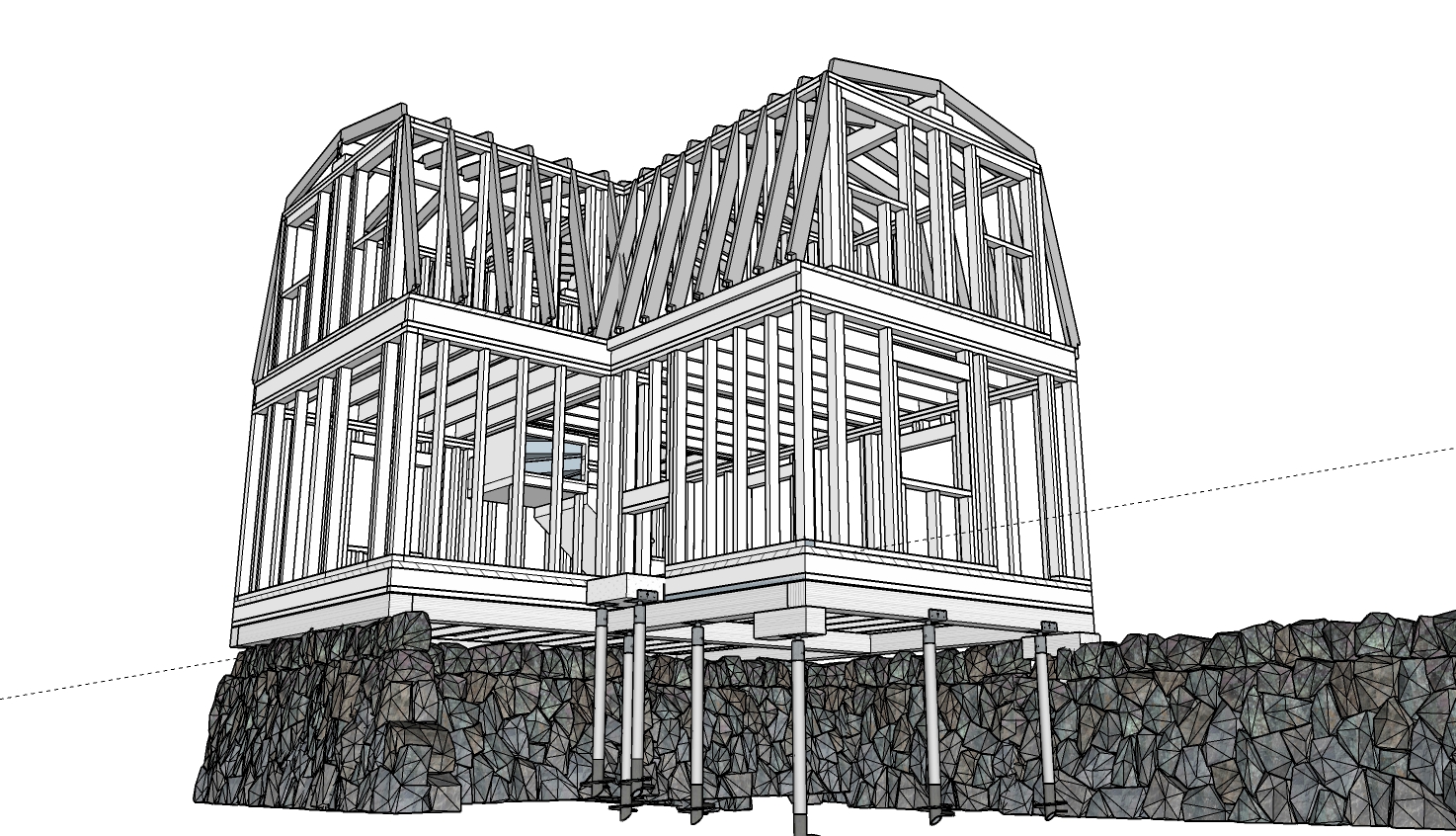
The second was a derelict home on the same reservation – long abandoned, measurable, photographable, but not a building most people would look at closely. Working from measurements and photographs supplied remotely, we identified a pre-contact longhouse fire pit that had been misread as a cellar foundation for over a century. We recognized tapered ground-set posts using Algonquian construction technique rather than European mortise and tenon joinery. We documented a construction sequence running from pre-contact indigenous building through settler occupation through reservation-period adaptation – all on the same ground, all readable in photographs and measurements that others on site had access to and walked past without seeing.
Neither project required a site visit. Both were done entirely from Ontario, working remotely from images and measurements.
The contractor was standing in that foundation hole with the physical evidence in his hands. We were looking at photographs on a screen in another country, reading things he walked past every day.
That’s what 40 years of hands-on construction knowledge looks like when applied to historic restoration and architectural investigation. The distance doesn’t change what the evidence says. It just changes who’s paying attention to it.
What Changes When Your Architectural Designer Has Built With Their Own Hands
When your designer understands construction at that level, several problems disappear.
No change orders from unbuildable details. No cost overruns from designers who don’t know what things actually cost. No delays from contractors pushing back on impossible specifications. No rebuilds from mistakes that looked fine on paper.
What you get instead is renovation design and custom home drawings that contractors don’t fight against. 3D photorealistic renderings that show exactly what will be built. Cost projections based on what materials and labor actually cost in the current market. Details developed from four decades of on-site problem solving across hundreds of projects in North America.
80% of our 2024 clients were American builders and homeowners. They found us because digital delivery is faster than local architects, the drawings are more buildable, and the Canadian exchange rate works in their favor.
Custom Home Design and Renovation — The Whole Property
Early in our career, architect colleagues explained their scope simply. “What we do starts at the front door and ends at the back door.”
We never accepted that. Great architectural design considers the whole property – the entrance, the landscape, the outdoor structures, the way a building sits on its site. We’ve been designing holistically for decades, guided by the principle that every home and landscape should look like it grew there naturally.
When you work with us you’re not just getting a building. You’re getting a complete environment.
What We’re Best At
Custom homes that look historic but perform to modern standards. Additions that connect to existing structures without looking like an afterthought. Renovation design for challenging properties that other designers avoid. Historic restoration that works from physical evidence rather than guesswork. Complex and unusual problems across residential and heritage properties throughout North America.
If your project is straightforward, there are plenty of architectural designers who can handle it.
If it isn’t, call us.
One More Thing
Current net-zero building methods have serious problems. We’re already seeing mold and rot from code-mandated specifications that ignore building science realities. Over the next few years we’re developing a better approach to residential construction – more efficient, longer-lasting, and designed for how people actually live.
Watch for future case studies on these issues.
We’ve been through 40 years and multiple economic cycles. We’re not done improving things.
Ready to talk about your renovation design or restoration project? Contact us here.